You know that recurring 30-minute block on your calendar? The one labeled “1:1 with [Manager Name]”? Most engineers treat it like a necessary evil, a status update between a performance review that neither party really wants to attend.
I’ve sat through hundreds of these meetings from both sides. As an engineer, I dreaded the awkward silences and forced small talk. As a manager, I watched talented developers zone out while I asked generic questions about their week. We were all doing it wrong.
The turning point came when I realized something fundamental: we’d been treating 1:1s like project management meetings when they’re actually relationship and career accelerators. This isn’t about tracking tickets or reviewing code. It’s about the conversations that shape careers, build trust, and solve the human problems that no amount of documentation can fix.
Research backs this up dramatically. Teams with regular, well-run 1:1s show engagement rates that are triple the average. They ship better code, have lower turnover, and handle conflict before it explodes. Yet most engineering organizations run these meetings on autopilot, wasting many hours per year per person on conversations that could’ve been emails.
The difference between exceptional 1:1s and terrible ones isn’t complicated. It comes down to understanding who owns the meeting, what belongs in it, and how to make the awkward parts productive. Once you get these fundamentals right, everything else follows.
In particular, we will talk about:
Why 1:1s matter. How 1:1s differ from other meetings and why they’re critical for engineer retention and team performance. The real purpose behind these meetings that most people miss.
This is your meeting, not your manager’s. Who owns what in a 1:1 and why treating it like a status update kills its value. How both engineers and managers should prepare and show up.
Agenda: Use a flexible framework. The People/Product/Process framework and how to apply it without becoming rigid. Structure as a safety net, not a script.
Great questions lead to great answers. Questions that unlock real conversations versus ones that get you nowhere. Specific examples and the 70/30 listening rule that changes everything.
Have the awkward conversations. Creating psychological safety and bringing up the topics you can’t discuss anywhere else. Why discomfort signals you’re doing it right.
Make the logistics matter. The practical details that make or break 1:1s: frequency, duration, documentation, and pre-work.
For managers: Stop talking and start coaching. Shifting from problem-solver to coach. How to develop decision-makers instead of creating dependencies on you.
What to avoid. Common mistakes that destroy the unique value of 1:1 time.
Start simple, then iterate. Evaluating whether your 1:1s work and how to improve them over time.
A 1:1 isn’t just another meeting. It’s dedicated personal time with your direct report. In fact, 1:1s aren’t about the work itself; they’re about the person who does the work. When you treat 1:1s as optional or purely tactical check-ins, you lose one of your best chances to build trust, surface issues early, coach growth, and retain great engineers. Consistent, well-run 1:1s can transform a team’s performance and morale.
Think of a 1:1 as a safety valve and springboard: a place to catch problems before they explode, and to nurture an engineer’s development before they stagnate. It’s their time to talk freely, and your time to listen and support. Keep that purpose in mind at all times.
This is your meeting, not your manager’s
First-time managers obsess over task management in 1:1s. They open Jira, review tickets, and turn the entire session into a status sync. This is the cardinal mistake. Your manager already has dashboards, standups, and async updates for tracking work. The 1:1 exists for things that don’t fit anywhere else.
For engineers: Come prepared with what matters to you (have an agenda!). It could be: career goals, work priorities, or personal development. The meeting should cover your career growth, relationships with teammates, obstacles blocking your work, and feedback in both directions.
For managers: Your job is to empower employees to solve their problems and help them navigate roadblocks. Remember, the 1:1 is their forum; encourage them to add to the agenda. But as the manager, you should have a few prompts ready to kindle a meaningful discussion.
Finally, set a welcoming tone. I like to begin with a bit of genuine small talk: ask about their weekend, their new house plant, or how their life’s been lately. Be personable.Showing that you care about them as a human (not just a coder) helps build the trust needed for candid conversations.
The ownership distinction matters. As the engineer, you own the agenda and pre-work. As the manager, you’re ultimately responsible for the relationship and outcomes. This tension is intentional.
Powerful one-to-one isn’t what we expect (Image: Freepik)
Agenda: Use a flexible framework (not a status checklist)
The 1:1 is a higher-leverage conversation. As one seasoned engineering manager told me, “The 1:1 should focus on the employee’s needs, not just status updates.” In other words, it’s a forum for topics that don’t fit neatly into Jira tickets or team meetings.
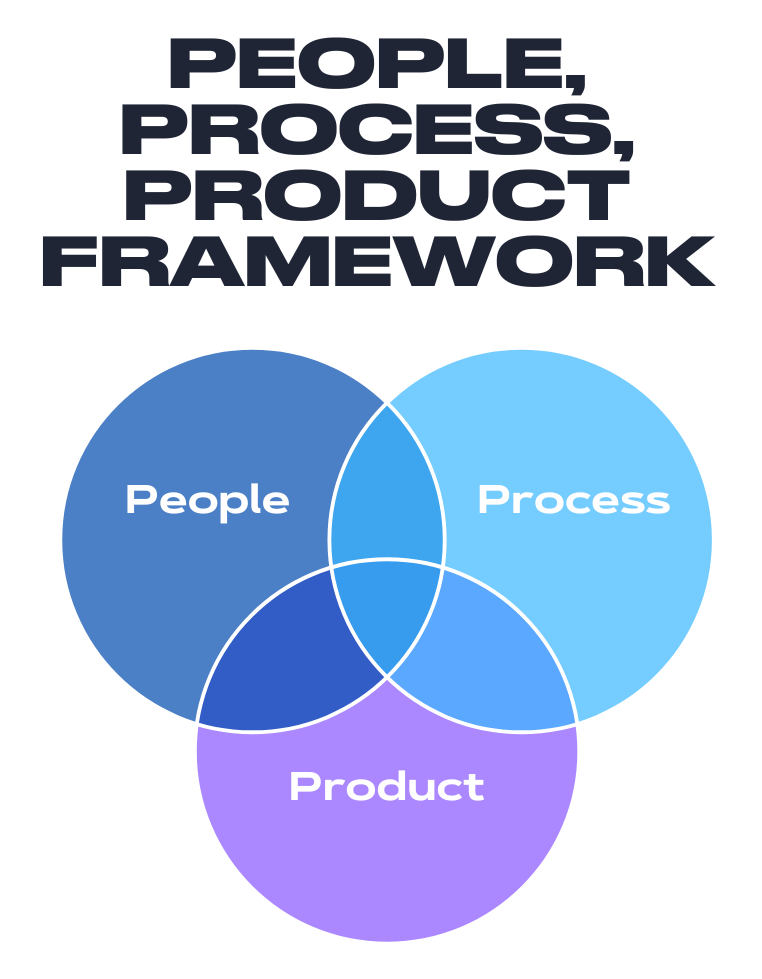
That said, having a loose structure or framework can ensure you cover important ground. One effective format I’ve used is the classic “People, Product, Process” approach
People (5min): How are team dynamics and relationships? (e.g., “How are things going with the team?”). This can reveal interpersonal issues or successes.
Product (10min): What’s the focus of their work? (e.g., “What have you been working on lately?”). Not a detailed status, but a high-level view of progress, victories, or blockers.
Process (10min): Are there any tools, process issues, or general improvements that would make their work life better? (e.g., “Anything we can do to make your day-to-day easier or happier?”).
People, process, product framework
This structure is just a guide – adapt it to what works for you. The goal is to touch on the person, their work, and the environment. Often, I won’t even formally announce these sections; I keep them in mind to steer the conversation. If the discussion naturally dives deep into one area, that’s fine. You don’t need to cover every category every time, as long as the conversation is valuable.
Throughout the 1:1, let the employee lead as much as possible. If they come in with something pressing to discuss, run with that. Your framework is a safety net to ensure you don’t miss topics that matter, not a rigid script.
Great questions lead to great answers
Great 1:1s are driven by open-ended, thought-provoking questions - and a lot of listening on your part. If you’re doing most of the talking, something’s off. A good rule of thumb is to let the direct report talk ~70% of the time, with you talking 30% (mostly asking questions, guiding gently, and clarifying).
Resist any urge to dominate the conversation or fill every silence. Silence can be golden. It often means the other person is thinking. Give them space to reflect and respond.
When you do ask questions, avoid the generic and shallow. “How’s it going?” will usually get you “Good, you?” and then awkward silence. Instead, ask deeper questions that encourage reflection and honesty.
For example, instead of “Everything on track?”, you might ask, “What’s been the most challenging part of this project for you?” Compare “How’s the team?” to “Who’s someone on the team you’ve enjoyed working with lately – and anyone who’s been hard to work with?”
The latter invites a meaningful answer. Dig past the surface: if they give a short, safe answer, follow up with “Why?” or “Tell me more about that.”
And remember: listen actively. Show you’re listening by maintaining eye contact (or active engagement on video calls), nodding, and occasionally paraphrasing what you heard. This is their time to be heard. Your job is mostly to listen, understand, and ask the right follow-up questions.
Examples of great 1:1 questions:
What’s something you’re proud of this week? (Or something that frustrated you?)
Is anything blocking your progress or draining your energy lately?
How do you feel about the team’s collaboration and communication recently?
What skills or areas do you want to grow in over the next few months?
What’s one thing I could do better to support you or make your job easier?
These kinds of questions spark dialogue beyond “everything’s fine.” They can uncover hidden issues or aspirations. As the manager, pay attention to both what’s said and what isn’t. If a report consistently says “All good” but seems hesitant, gently probe further or rephrase the question next time. Over time, as trust grows, they’ll open up more.
How to listen properly?
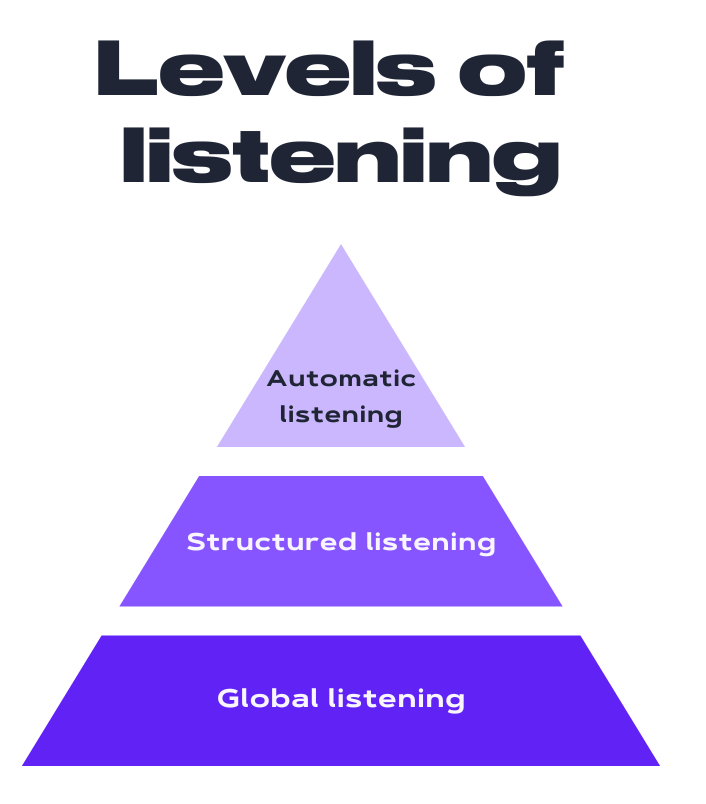
👂 In general, there are three levels of listening:
We listen for content. Here, we notice what is said, words, facts, etc.
We listen for structure. Here, we notice behavior, emotions, and so on.
We listen deeply. Here, we notice the whole picture, including values, beliefs, motivation, etc.
Combining all this, we will connect with people on a deeper level, so they feel like: “Wow, this person understands me, this person values me, I can talk to this person…”.
And remember that you have two ears and one mouth. This is not a coincidence!
Think about this before your next conversation.
Have the awkward conversations
The best 1:1s include topics you couldn’t discuss openly in Slack or standup. This is where you commit to saying the awkward things. “I’m confused about our team’s direction.” “Working with John has been frustrating.” “I don’t think I’m growing here.”
These conversations require psychological safety, which you build through consistent follow-through. When your manager commits to removing a blocker, they must actually do it. When you raise concerns, they should acknowledge them rather than getting defensive. Trust accumulates through dozens of small promises kept.
Share what motivates you and what drains you. Talk about areas where you want to grow. Express gratitude for what’s working and confusion about what isn’t. The vulnerability feels uncomfortable, but it’s precisely what makes 1:1s valuable.
For managers: Ask directly for feedback on how you’re doing. “What can I do better?” and “How are these 1:1s working for you?” are the fastest ways to improve. Most engineers won’t volunteer this feedback unless you explicitly request it.
Make the logistics matter
Consistency is non-negotiable. Weekly meetings give you 4x as many opportunities to catch problems early as monthly meetings do. Every canceled 1:1 without immediate rescheduling chips away at your relationship. Engineers judge managers by how they treat these meetings. Treat them as your highest priority calendar item.
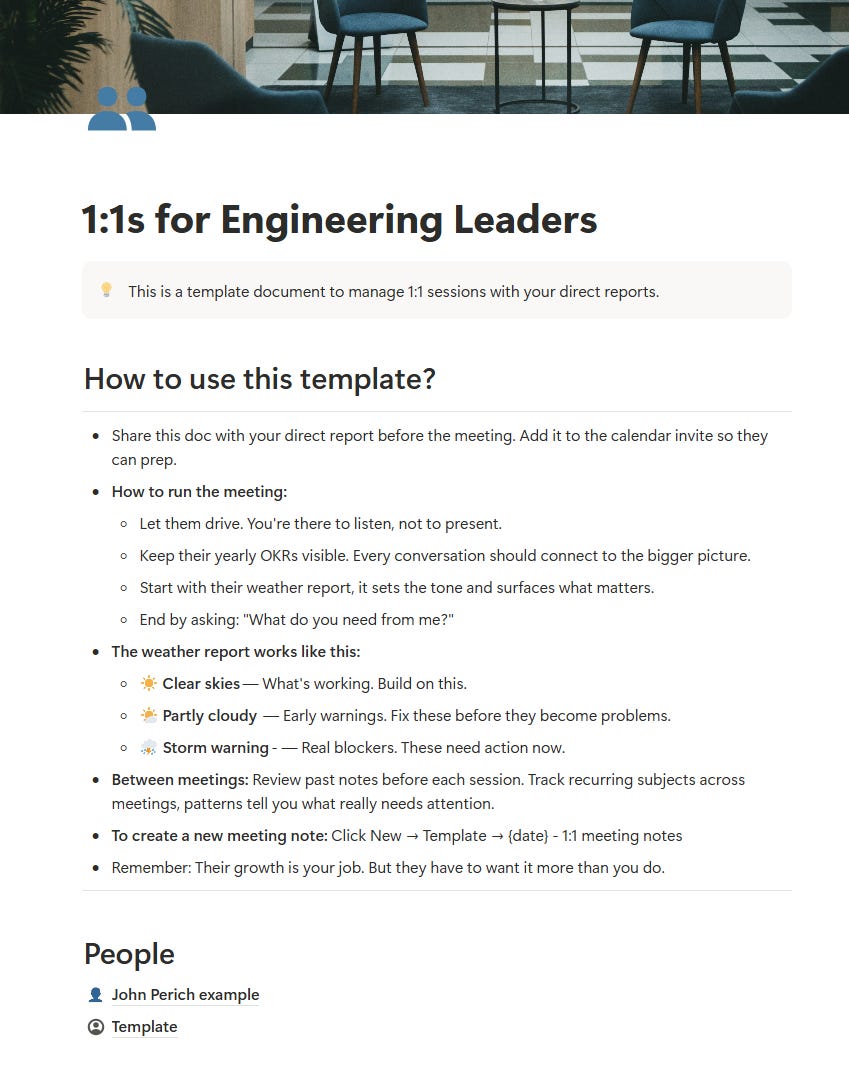
Next, set up a shared document. Notion, Google Docs, whatever, with reverse-chronological entries. Each week gets a date header with the three sections underneath. This running history creates mutual accountability. Write things down visibly during the meeting, notes, and action items. When your manager types “Finished database migration” while you’re talking, it shows they’re paying attention.
So, start the week with your 1:1 early enough to surface blockers, but not at 8 am when nobody wants to discuss career growth. Thirty minutes is the right default. If you’re consistently running over, extend to 45. If you finish early regularly, the meeting probably isn’t serving its purpose.
The pre-work matters enormously. Engineers should send a brief weekly wrap-up the day before: current priorities, any blockers, and what’s on their mind. Managers must read this before the meeting. Showing up unprepared signals disrespect more than anything you could say.
For managers: Stop talking and start coaching
Most engineering managers talk too much in 1:1s. They solve problems that engineers could solve themselves. They give advice before understanding the real issue. They fill silences that would’ve led to breakthrough conversations.
I’ve learned this from my experience, but when I learned more about coaching and how powerful it is, I realized that it is more than just managing people.
What we want to achieve:
Create psychological safety first. Your engineer needs to know they can say “I’m struggling” or “I disagree with our technical direction” without consequences. Build this by asking real questions and actually listening to the answers. “What’s on your mind?” beats “How’s everything going?” every time. The second question invites “fine.” The first invites truth.
Wear your coaching hat, not your solving hat. When an engineer brings you a problem, resist the urge to fix it immediately. Ask “What have you already tried?” and “What would you do if you had to decide right now?” You’re developing decision-makers, not creating dependencies on you. The hardest part is staying quiet when you know the answer. Do it anyway.
Make room for the messy stuff. Engineers often need to process emotions before they can solve problems. When someone vents about a frustrating code review or difficult teammate, don’t jump to solutions. Let them talk it out. Say “Tell me more” or just nod. Sometimes the venting itself is the solution. They’ll often talk themselves into clarity without you saying a word.
Hold people accountable without micromanaging. End each topic with “What’s your next step?” not “Here’s what you should do.” Write it down. Follow up next week. If they didn’t do it, ask “What got in the way?” not “Why didn’t you do this?” The first question uncovers systemic blockers. The second creates defensiveness.
Ask for reverse feedback every month. “What could I do differently to support you better?” works better than generic “How am I doing?” questions. Be specific: “Was there a moment this month where I could’ve handled something better?” When they give you feedback, say thank you and act on it. Nothing builds trust faster than changing behavior based on their input.
Remember: your success is measured by your team’s growth, not by how many problems you personally solve. The best engineering managers leave 1:1s having said less than 30% of the words. If you’re doing more than that, you’re probably managing too much and coaching too little.
Don’t use 1:1s only for status updates. If you’re spending 25 minutes reviewing what shipped, you’re wasting the unique value of dedicated one-on-one time. Handle that async or in team meetings.
Don’t dominate the conversation as a manager. If you’re talking more than 50% of the time, you’re doing it wrong. The engineer should drive the agenda and the discussion.
Don’t skip the follow-through. Dropped commitments erode trust faster than anything else. If you said you’d investigate the CI pipeline issues, do it before the next 1:1 and report back.
Don’t share notes or gossip. What’s said in a 1:1 stays private. The moment engineers think you’re repeating their concerns to others, they’ll stop being candid.
Don’t cancel without immediate rescheduling. This signals that the meeting, and, by extension, the engineer, is not a priority. Protect this time fiercely.
Most of these were mistakes I made during my 1:1s when I started working with people. Taking this into account will greatly improve your 1:1s with your people.
Start simple, then iterate
Good 1:1s feel like good product-market fit. Are you both excited for the meeting? Is the structure delivering increasing value? Would you be disappointed if you couldn’t have them anymore?
If the answer is no, ask for feedback on the 1:1s themselves. Try the People/Product/Process framework for a month. Write things down. Show up consistently. Listen more than you talk. Most importantly, remember these meetings exist to make engineers more effective and fulfilled in their work.
The best 1:1s are the ones where difficult topics surface early, small problems stay small, and trust compounds week after week. They’re not always comfortable, but they’re always worth it. Engineers who master 1:1s, from either side of the table, accelerate their careers and build stronger teams.
Weekly 1:1s are 30 minutes that determine whether engineers stay or leave, whether they grow or stagnate. Run them like they matter, because they do.
More ways I can help you:
📚 The Ultimate .NET Bundle 2025 🆕. 500+ pages distilled from 30 real projects show you how to own modern C#, ASP.NET Core, patterns, and the whole .NET ecosystem. You also get 200+ interview Q&As, a C# cheat sheet, and bonus guides on middleware and best practices to improve your career and land new .NET roles. Join 1,000+ engineers.
📦 Premium Resume Package 🆕. Built from over 300 interviews, this system enables you to craft a clear, job-ready resume quickly and efficiently. You get ATS-friendly templates (summary, project-based, and more), a cover letter, AI prompts, and bonus guides on writing resumes and prepping LinkedIn. Join 500+ people.
📄 Resume Reality Check. Get a CTO-level teardown of your CV and LinkedIn profile. I flag what stands out, fix what drags, and show you how hiring managers judge you in 30 seconds. Join 100+ people.
📢 LinkedIn Content Creator Masterclass. I share the system that grew my tech following to over 100,000 in 6 months (now over 255,000), covering audience targeting, algorithm triggers, and a repeatable writing framework. Leave with a 90-day content plan that turns expertise into daily growth. Join 1,000+ creators.
✨ Join My PatreonCommunity and My Shop. Unlock every book, template, and future drop, plus early access, behind-the-scenes notes, and priority requests. Your support enables me to continue writing in-depth articles at no cost. Join 2,000+ insiders.
🤝 1:1 Coaching. Book a focused session to crush your biggest engineering or leadership roadblock. I’ll map next steps, share battle-tested playbooks, and hold you accountable. Join 100+ coachees.
Want to advertise in Tech World With Milan? 📰
If your company is interested in reaching founders, executives, and decision-makers, you may want to consider advertising with us.
Love Tech World With Milan Newsletter? Tell your friends and get rewards.
We are now close to 50k subscribers (thank you!). Share it with your friends by using the button below to get benefits (my books and resources).